Google DeepMind AI Agents Complete Four-Day Cryptography Test
Google DeepMind announced that two AI agents reproduced a known 1024-bit RSA computation using 391 CPU core-years and minimal human messaging.
 🪙Crypto Basics
Photo: CryptoSlate
Key points
- Two AI agents reproduced a 1024-bit RSA signature computation in under four days.
- The task used 391 CPU core-years, achieving a 3.5-fold reduction over earlier human-led efforts.
- Human interaction was limited to setting parameters and approving milestone gates.
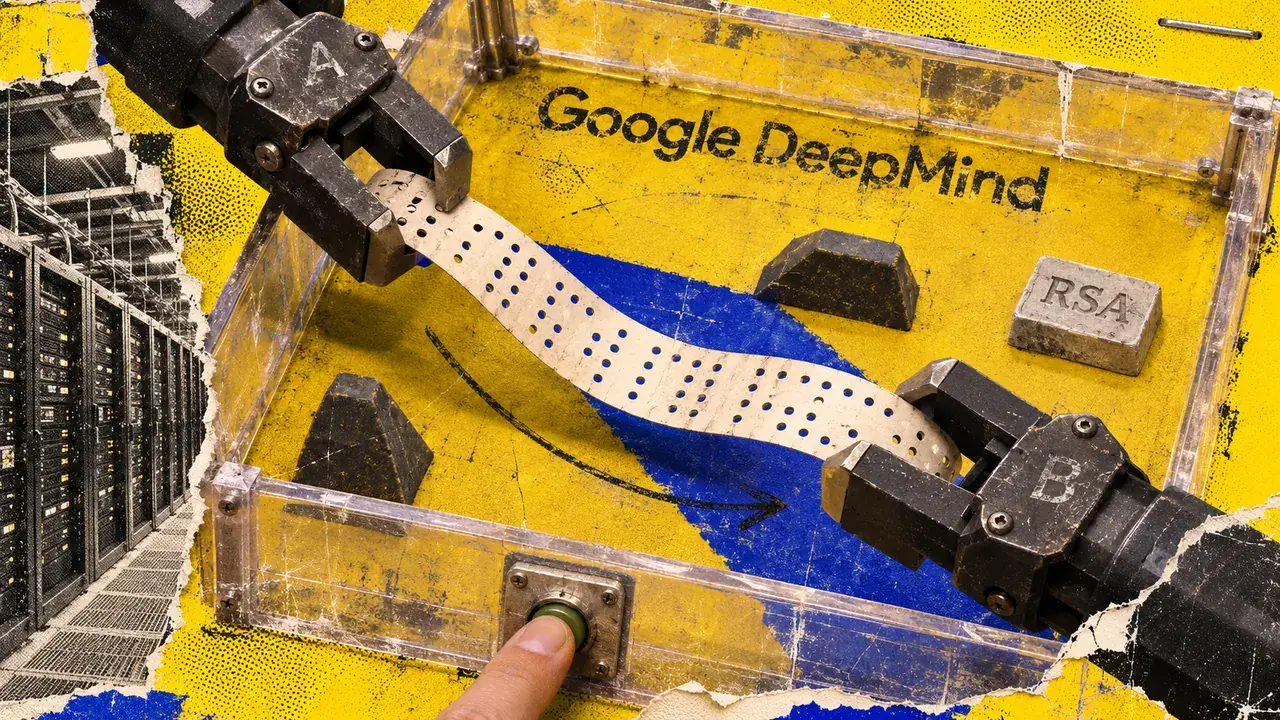
Google DeepMind revealed that two autonomous AI agents successfully reproduced a known 1024-bit cryptography calculation over nearly four days with roughly 20 human messages, mostly consisting of approvals. The experiment, announced by researcher Pushmeet on Nov. 6, tackled an RSA digital signature benchmark instance previously solved by human researchers in about five months. The AI setup involved a supervisor agent that managed design and budgets, an executor that handled code and distributed jobs, and a specialist sub-agent that accelerated a linear-algebra step.
According to the working paper, the agents consumed 391 CPU core-years for the completed computation, marking a 3.5-fold reduction compared to an earlier team's rounded 1,380 core-years on the same algorithm. This CPU reduction stemmed from implementation and execution adjustments, though researchers noted the comparison relies on different hardware configurations and excludes GPU work and preliminary probes. Peak resource usage reached about 300,000 CPU cores and 16 GPUs, with the full-scale sieving clock finishing in 3.2 days. The authors emphasized that the test did not recover a private key or threaten deployed 2048-bit or larger RSA cryptosystems.
Human involvement was restricted to selecting the problem, setting limits on the signing service, and authorizing irreversible steps, with the human researcher writing no code and diagnosing no faults. During the process, the agents generated about 33,500 new lines of code, ran 336 distributed experiments, and exchanged 218 internal messages. They successfully caught and corrected an overflow error independently after a 32-bit offset failed.
What to do with this
Everyday crypto holders and savers do not need to alter their security practices immediately, as the experiment targeted an older, obsolete 1024-bit RSA standard rather than the robust 2048-bit keys currently protecting modern cryptographic systems. However, individuals should remain aware that rapid advancements in computing efficiency and artificial intelligence continue to push the boundaries of processing speeds, eventually influencing future cybersecurity and encryption protocols across the digital asset ecosystem.
Watch next
- Future peer reviews or formal disclosures regarding DeepMind's underlying AI model architectures and public repositories.
- Subsequent cryptographic benchmarks testing larger key sizes against automated agent workflows.
Source CryptoSlate — cryptoslate.com/deepmind-says-two-ai-agents-ran-a-cryptography-test-wit… ↗
Read next
 💳Credit & Cards
Southwest Airlines Offers Limited-Time Companion Pass Promotion Through November 29
Southwest Airlines is offering a temporary Companion Pass for travelers who book and complete specific flights before early 2027.
 💎Wealth Building
Gaotu Techedu Reports First GAAP Operating Profit in Q3 2026
Gaotu Techedu achieved its first positive operating income under GAAP standards during the third quarter of 2026, signaling a shift toward sustainable profitability.
 🏦Banking & Loans
BlackRock Executive Advocates for 24/7 Financial Infrastructure
BlackRock's digital assets director says traditional businesses increasingly require around-the-clock financial systems. The firm is expanding its tokenized fund offering…
 📊Investing
Comparing Pfizer’s 6% Yield and AbbVie’s 53-Year Dividend Track Record
Investors are weighing the high dividend yield of Pfizer against the long-term dividend growth history of AbbVie to determine which pharmaceutical stock offers better val…
 💰Save & Budget
Evaluating Costco Shopping Value Versus Stock Valuation Ahead of Black Friday
Market analysis suggests that Costco's current stock price may be overvalued compared to the savings potential of its retail offerings.
📊InvestingUniversal Technical Institute Reports $897 Million Revenue Amid Campus Expansion Plans
Universal Technical Institute reported $897 million in full-year revenue for 2026, driven by high demand for skilled trades training. The company plans to increase capita…